显示标签为“科技”的博文。显示所有博文
显示标签为“科技”的博文。显示所有博文

2009年5月1日星期五

奔驰要在5年内实现风阻系数0.2


为了制造出更节能环保的汽车,奔驰正在减小车的风阻系数上大下功夫。

E Coupe就是最好的证明,0.24的风阻系数,全世界最小的。流线造型的车风阻应该会比较小,但SLR McLaren风阻0.3,完全看不出E Coupe哪儿比SLR更会切割空气,空气动力学是不能光靠眼睛看的。

奔驰项目经理Rainer Tiefenbacher说:“20年前我们达到了风阻0.3大关,5年内,我们肯定会再进一步。”


来自:autocar.co.uk


更多
E级Coupe敞篷版图片泄漏
奔驰E级Coupe(C207)正式发布


阅读全文...

2009年1月14日星期三

奔驰3款零排放BlueZERO概念车


NAIAS上不只有新E级,还有外观一样的三款概念车,BlueZERO E-CELL、BlueZERO F-CELL和BlueZERO E-CELL PLUS。详情请见底特律车展:奔驰BlueZero电动概念车*


官方新闻

Mercedes-Benz Concept BlueZERO: three-fold proof of the everyday practicality of zero-emission vehicles
Stuttgart
,
Jan 11, 2009


Current challenges such as growing worldwide mobility requirements, declining crude oil reserves, and increasingly stringent exhaust emission regulations are making the electric car more and more a focus of public attention. Thanks above all to major advances in battery technology, electric drive is seen as a promising answer to the question of how individual mobility can be made sustainable.
Battery-electric drive systems offer a wealth of advantages in this respect: they provide a high level of torque, are compact and quiet, run extremely efficiently and with zero local emissions, and they operate without the need for fossil fuels. However, it is not currently possible to fulfill all mobility requirements with a single electric vehicle concept. Those who drive predominantly or even exclusively in urban areas do not place as much emphasis on vehicle range but very much like the idea of lower noise levels and emissions. For such customers, a battery-electric vehicle is an attractive solution.
Those who also wish to cover long distances on country roads and motorways combined with low noise levels, no local emissions, and short refueling times have a viable alternative in the shape of the fuel-cell electric vehicle. This technology clearly shows the way ahead in terms of sustainable mobility after the "crude oil age" but requires a hydrogen-fuel-supply infrastructure. The beneficial combination of maximum range, fast energy storage on board from an existing infrastructure, and noiseless and locally emission-free mobility in urban areas is offered by a battery vehicle with range extender.
Concept BlueZERO: modularity assures optimal everyday practicality
The sandwich-floor architecture and the modular design allow three different drive configurations that are able to meet an extremely wide range of different requirements. Measuring 4.22 meters in length, 1.89 meters in width and 1.59 meters in height, the extremely compact BlueZERO concept offers decisive design advantages over electric cars based on conventional vehicle platforms and designed only for use in combination with internal combustion engines.
  • Interior space is retained in full. As the energy accumulators/generators are integrated into the spacious sandwich floor, no compromises are necessary with respect to passenger space, luggage capacity, or variability.
  • The powertrain technology located in the sandwich floor and integrated directly at the front axle assures a low centre of gravity and, consequently, extremely reliable and agile handling.
  • Crash safety is of the extremely high standard associated with Mercedes thanks partly to the housing of the powertrain components between the axles.
Furthermore, all three BlueZERO electric cars are highly suitable for electromobility in urban areas on account of their compact dimensions, easy entry and exit, raised sitting position, and optimal all-round visibility. All of which makes Mercedes-Benz the first and, to date, only car manufacturer in the world to offer three optimal solutions that meet all customer electromobility requirements.
Intelligent sandwich platform assures the highest possible level of safety
Featuring a modified version of the sandwich-floor platform, the BlueZERO concept sets standards for the electric car sector in all areas relevant to day-to-day motoring. The best possible crash safety is assured, since almost all of the drive components are housed within the sandwich floor, that is to say in the protected area between the axles.
Typically for this class of car, all three versions of the Concept BlueZERO are front-wheel drive models with an electric motor at the front axle. The batteries are located in the center of the vehicle floor behind this, in a position which protects against intrusion in the event of a frontal or rear impact, since the energy accumulators are located outside of the body's impact and deformation zones. Furthermore, the extremely robust construction of the sandwich floor can offer a high level of protection for both the battery and the occupants, even in the event of a side collision. This advantage is also of economic benefit, since the battery is the largest cost factor in electric drive systems. Consequently, if the battery remains undamaged in an accident, the follow-up costs are reduced considerably. By virtue of its proven nutshell effect, the sandwich floor is the safest place for housing the still relatively expensive energy accumulators.
Room for five occupants and luggage thanks to highly efficient use of space
This clever sandwich construction also has obvious advantages where packaging is concerned: locating the drive modules in an underfloor position makes it possible to retain all of the passenger and luggage space in this 4.22-meter long five-seater, with no restrictions whatsoever. In the purely battery-powered BlueZERO E-CELL, for example, up to two of the lithium-ion battery packs developed by Mercedes-Benz can be accommodated in the sandwich floor.
In addition to exemplary safety and unrestricted everyday practicality, the BlueZERO models have further strengths that are by no means the norm for electric cars, namely agility and driving enjoyment. This is in large measure due to the low centre of gravity, another benefit of the low installed position within the sandwich floor, and the front axle suspension. In combination with uncompromising attention to centered masses, this results in outstanding roadholding and handling agility.
Modular drive concept for individually configured electric vehicles
Mercedes-Benz will present two BlueZERO variants at the 2009 NAIAS show in Detroit: the BlueZERO E-CELL as a purely battery-powered vehicle and the fuel-cell version, the BlueZERO F-CELL – both of which are emission-free in local operation. Mercedes-Benz development engineers are also working on a third version with a range extender, the BlueZERO E-CELL PLUS. This is additionally equipped with a compact internal combustion engine as a generator that produces power during a journey.
All these models feature battery packs based on the latest lithium-ion technology. This new battery technology has decisive advantages over conventional battery types, among them very compact dimensions, significantly higher performance, excellent reliability, and a long operating life. The identical components used in the modular system also include the compact, permanent-magnet synchronous electric motor, which operates at a maximum of 13,280 rpm. It develops a peak output of 100 kW and a continuous output of 70 kW. Its peak torque is 320 Nm, while the continuous torque is 180 Nm. The maximum torque is available from the first revolution of the electric motor and exceeds the figure achieved by a current V6 gasoline engine at 2500 rpm.
BlueZERO E-CELL: agile, quiet and locally emission-free
The BlueZERO E-CELL is equipped with a lithium-ion battery with a capacity of 35 kilowatt hours (kWh). The liquid-cooled high-voltage cells have an operating voltage of 240 to 426 V. With this battery, the BlueZERO E-CELL has an operating range of up to 200 kilometers. Recharging the empty battery takes three to four hours. The BlueZERO E-CELL accelerates from zero to 100 km/h in less than eleven seconds and, in the interests of optimal range and energy efficiency, has an electronically limited top speed of 150 km/h.
BlueZERO F-CELL: emission-free driving on long journeys with the fuel cell
The new-generation fuel cell used in the BlueZERO F-CELL is more compact and – with a maximum output of 90 kW (continuous output 80 kW) – also more powerful than its predecessor. It can be cold-started at temperatures down to minus 25 degrees Celsius and also has the benefit of short refueling times.
On the road, the BlueZERO F-CELL assures a high standard of dynamic handling, yet this family-friendly compact car consumes just 2.9 liters of fuel (diesel equivalent) per 100 kilometers. According to the NEDC, the BlueZERO F-CELL
is able to cover well over 400 kilometers on one tank of hydrogen.
In the fuel cell version of the BlueZERO, the electric motor, high-voltage battery, and hydrogen tank are likewise positioned beneath the passenger cell to save space. The system uses the most efficient energy source for the current driving situation. When parking or maneuvering at slow speed, for example, the electric motor uses only battery power. When accelerating, energy is provided by both the fuel cell and the battery. When braking, the electric motor acts as a generator and charges the battery. This efficient system therefore makes use of the energy that would be converted into heat during conventional braking and stores it in the powerful lithium-ion battery.
For longer journeys too, Mercedes-Benz sees the fuel cell as one of the key technologies for zero-emission driving. Providing a suitable network of hydrogen filling stations is in place, this technology offers ideal possibilities for sustainable mobility well into the future. The hydrogen-powered fuel cell combines zero emissions with a long operating range, since electrical power is generated on board during the journey. There are no exhaust emissions whatever, and no CO2 is emitted either. The BlueZERO F-CELL emits nothing more than steam. Moreover, a fuel cell drive system is almost twice as efficient as an internal combustion engine.
BlueZERO with range extender: flexible solution with a long range
In the third version, the BlueZERO E-CELL PLUS, the Mercedes engineers combine the electric drive system from the purely battery driven BlueZERO E‑CELL with an additional internal combustion engine that serves as a range extender. The compact 50-kW three-cylinder turbocharged gasoline engine from the smart fortwo charges the battery whilst the car is being driven.
Advantage of the range extender: as with conventionally powered cars equipped with a gasoline or diesel engine, the customer benefits from a significantly longer range (up to 600 km), especially as the BlueZERO E-CELL PLUS can also be quickly and easily refueled at any normal filling station. The customer can therefore be sure that the car is available for use anywhere and at any time. And when an urban area is reached after an overland journey, the driver can continue on their way under electric power alone.
The BlueZERO E-CELL PLUS therefore allows electric mobility at the touch of a button, a particular benefit in densely populated urban areas with environmental zones, toll charges, and other access restrictions affecting cars with internal combustion engines.
The BlueZERO E-CELL PLUS with the range extender clearly highlights the advantages of the sandwich-floor platform: here too, the key drive components are integrated in the underfloor area to save space. The internal combustion engine is installed near the rear axle, in the spare wheel well. Thanks to the range extender, the BlueZERO E-CELL PLUS has a range of up to 600 kilometers, of which 100 kilometers are in locally emission-free electric mode, with no drop in performance. The NEDC fuel consumption is 4.5 liters per 100 kilometers. In conjunction with a plug-in battery and the resulting CO2 bonus, the car emits just 32 grams of CO2 per kilometer.
In addition, the highly efficient modular concept allows further variants to be individually configured. If the system is designed appropriately, the internal combustion engine used as a range extender can also be employed temporarily as a direct drive unit – when driving on country roads, for example. This setup leaves the full battery capacity available for driving in town. Other conceivable variants might be to use the fuel cell as a range extender, or a combination of the fuel cell and plug-in batteries. Thanks to this versatility, the Mercedes-Benz modular electric drive concept is able to cover every conceivable option for electric driving.
Instead of a fuel filler cap, the car features plug-in connectors to EU and US standards for rapid recharging with electrical power. One contact is intended for conventional power cables that fit any household power socket. The second is suitable for connection to public recharging stations.
BlueZERO design: both elegant and functional
Cutting-edge technology is very attractively packaged in all the BlueZERO variants. The future-oriented yet unmistakable Mercedes-style body contours accentuate the progressive nature of the Concept BlueZERO at first glance.
The Mercedes-Benz designers have emphasized this aspiration by introducing paint finishes in three new ALU-BEAM colors. Each of the three variants makes its individual mark: the BlueZERO E-CELL is painted in fresh ALU-BEAM yellow, while the BlueZERO F-CELL has ALU-BEAM green paintwork. Confidence-oozing ALU-BEAM orange was chosen for the BlueZERO E-CELL PLUS.
Striking design idiom with bionic structures
The striking character lines along the flanks give this compact concept car a very dynamic side line and accentuate its bionic structure. This characteristic feature of the Mercedes-Benz bionic car was adapted and modified for the Concept BlueZERO. These elements lend the body design its dramatic power.
The lower line emerges from the flank in the front doors at the height of the wheel hub, then rises gently to turn steeply upwards and harmoniously continue the body line to the tail lights. This has the effect of stretching the body in visual terms, while suggesting dynamic forward movement despite the comfortable vehicle height. The precisely placed edges break the light to striking effect and lend the BlueZERO a masculine character that is a hallmark of the new Mercedes-Benz design idiom.
Translucent surfaces make the normally concealed technology visible. The light-gray tailgate is made completely from lightweight but highly robust Lexan, allowing a view of the aluminum structure that makes up the rigidifying frame, for example. At the same time, this transparent tailgate provides a view of the vehicle interior, making the advantages of the sandwich-floor platform obvious at a glance: the luggage compartment and passenger area remain fully usable, since there are no technical components that need to be accommodated here.
Key features at the distinctive rear end of the BlueZERO models include tail lights in the form of a curved "L", whose flame-like shape add a futuristic touch. In addition, the Mercedes designers have achieved a new-quality light production: four transparent lenses produce a red light curtain which tapers smoothly towards the sides, creating a lightly diffused effect.
This effect is repeated, albeit in white this time, by the front headlamps. What's more, the front lights feature new lens technology and a plexiglass edge to produce "C" shaped daytime driving lights with the help of state-of-the-art LED technology. The extremely energy-efficient LED technology offers the same brightness but requires ninety percent less power than conventional lights. 
The lenses are held by supports which also serve as direction indicators.
Aerodynamic design with eye-catching effects
The radiator grille with its centrally located star and even more pronounced V‑shape is a striking reinterpretation of the world-famous Mercedes-Benz radiator grille. The excellent aerodynamics of the BlueZERO are partly due to the closed front apron, whose design dispenses with any cooling air intakes. The 20-inch wheels are also aerodynamically optimized. Low-friction tires are fitted to reduce rolling resistance.
Like many other design features, the wheel covers are transparent and allow a view of wheel spokes, which are visually enhanced with three-dimensional light effects. All BlueZERO variants are also equipped with a semi-transparent, lightweight panoramic roof into which solar panels have been integrated. The thin-layer cells used here allow 20 percent of the light into the interior. Given enough sunlight, they generate sufficient electric power to charge cell phones or mobile MP3-players, for example.
Progressive interior design
The interior features an all-new, progressive design idiom: the lines are curved and blend in subtly with the organic surfaces. The Concept BlueZERO is a logical continuation of the bionic design line and is similar to the Mercedes-Benz bionic car. A wealth of structures inspired by nature and modeled based on organic growth can be found in several of the paneling components: in the door stowage areas, the cockpit, the centre console, the load compartment, and the load sill guard.
The array of colored transparent surfaces lends the interior a feeling of lightness. This is enhanced by semi-transparent surfaces whose edges form striking light breaks. This interplay between transparency and edge emphasis contrasts extremely well with the soft design idiom. The suggested fluorescent conductor paths in the center console represent the advent of a future drive technology.
The sporty front seats feature seemingly inserted upholstery and dynamically shaped backrests. The overall impression is one of lightness and litheness, all 
of which makes the vehicle interior feel much more open. As a five-seater, the Concept BlueZERO offers the flexibility and functionality of a modern-day compact car.
The material concept is largely based on a tone-in-tone composition enriched by touches of color. By way of example, the belt color and the seam thread in the paneling components establish a link with the car's exterior, while the leather strip in the seats creates a visual link with the high-quality steering wheel.
Thanks to their surface quality, the materials are highly resistant. The material mix of textiles and plastics combines a high level of value with high-tech appeal.
Concept BlueZERO: a blueprint for efficient electromobility
With the BlueZERO concept studies, Mercedes-Benz provides a very specific outlook on the immediate future of electric motoring. Major components of this modular drive concept will shortly be used in standard-production cars made by Mercedes-Benz. These include the fuel cell drive system, which will enter small-scale production in 2009. In 2010, the first Mercedes-Benz electric car will also be introduced into small-scale production.
Modular design as a strategic guideline
With this intelligently conceived modular system, Mercedes-Benz will also be able to realize tailor-made drive configurations for individual requirements in the electric car sector. For the brand's clients, this means a wide choice of purpose-made, efficient, and affordable solutions.
The product implementation presented by Mercedes-Benz on its "Road to the Future" is uncompromisingly wedded to the modular design principle: modular drive technologies that can be used individually or in combination depending on vehicle class, operating profile, and customer requirements are a key factor in this.
Modular drive concept also for hybrid vehicles
This particularly applies to hybrid models such as the S 400 BlueHYBRID, which is due to be launched in 2009 as the most economical gasoline-powered luxury saloon and CO2 champion in its class. For its hybrid models with gasoline and diesel engines, Mercedes-Benz has developed a modular system which can be expanded with respect to performance and range of applications.

  • In the S 400 BlueHYBRID, the hybrid module with its start-stop function, recuperation and boost effect already makes considerable savings possible.
  • With a suitable configuration, it is also possible to drive under electric power alone with this hybrid module, while the operating range in electric mode depends on the battery capacity.
  • The plug-in hybrid represents a further step, where the battery can also be charged from the mains in order to increase the electric operating range.
Intelligent drive mix for sustainable mobility
In the view of Mercedes-Benz, there will be no single technology as the ideal solution for sustainable mobility in the future. Instead the company is responding to the varied requirements with equally versatile solutions. The respective advantages of the individual technologies in terms of optimal fuel consumption and emission values are applied in specific application areas. Mercedes-Benz is basing its strategic planning for the future of individual mobility on the following mix of drive systems:
  • For long-distance operations, sophisticated internal combustion engines with or without a hybrid module will be used, as well as fuel cell powered vehicles.
  • For rural operations, plug-in hybrids will increasingly be added to the mix.
  • For urban operations, locally emission-free vehicle concepts with battery and fuel-cell drive systems are considered to be the most suitable.
The electric drive configuration presented in the Concept BlueZERO does full justice to this requirement profile. Mercedes-Benz has conducted intensive research in the field of fuel cell technology since as early as 1991 and, therefore, has enormous experience with electro- mobility. The brand has the world's largest fleet of fuel cell powered vehicles undergoing client trials, for example.
And in the field of battery-powered vehicles, the company has also gained unrivalled experience from fleet trials involving 100 smart electric drive cars in London. The Concept BlueZERO impressively reflects this in-depth know-how.

阅读全文...

2008年12月12日星期五

底特律车展:奔驰BlueZero电动概念车*


BlueZero概念车将在明年1月11-25日的底特律车展上展出。BlueZero概念车基于B级设计,从它的外观设计上可以预见2010年的下代B级外观。它的重点在于3种清洁的动力方案:
E-Cell,纯动力车,由一个锂电池和电动机提供100kW的马力和320Nm的扭矩,充电2小时能行驶100km;
E-Cell Plus,就比E-Cell多了个来自smart的3气缸涡轮增压汽油机,可以制造更多电力,结果是延长至600km的里程;
F-Cell,氢动力!零排放,奔驰1997就在A级上这样干过了。
外观好看吗?我建议过段时间再来审视。就像F700,乍一看挺可怕的,可后来我觉它很漂亮,只是尾灯不太协调罢了。


1997年A级氢动力概念车

新增4张来自eMB的局部照片:


来自:AutoBild德译英

更新:

官方新闻

Mercedes-Benz presents a modular drive concept for electric vehicles: Mercedes-Benz Concept BlueZERO: three-fold proof of the everyday practicality of zero-emission vehicles
Stuttgart,Dec 15, 2008

Mercedes-Benz is showing the way ahead in environmentally responsible electromobility by presenting its near-series Concept BlueZERO at the North American International Auto Show in Detroit. Based on a single vehicle architecture, this intelligent, modular concept allows three models with different drive configurations, all of which are able to meet customer requirements in terms of sustainable mobility:
  • the BlueZERO E-CELL with battery-electric drive and a range of up to 200 kilometres using electric drive alone

  • the BlueZERO F-CELL (fuel cell) with a range of well over 400 kilometres using electric drive

  • the BlueZERO E-CELL PLUS with electric drive and additional internal combustion engine as power generator (range extender). This version has an overall range of up to 600 kilometres and can cover a distance of up to 100 kilometres using electric drive alone.


The three BlueZERO variants are based on the unique sandwich-floor architecture which Mercedes-Benz introduced some ten years ago, initially for the A-Class and then for the B-Class, one of the aims being to integrate alternative drive systems. Advantages of the modified construction include the positive effect of the major drive components on the centre of gravity, their space-saving design and the fact that they are extremely well protected within the vehicle underbody. The five-seater BlueZERO concept cars also set standards in terms of lightweight design, interior layout and body form.

"The flexible BlueZERO concept allows electromobility for every requirement and highlights the fact that Mercedes-Benz is the world's only car manufacturer to already have in place all the key technologies for electric cars offering full everyday practicality", says Dr Dieter Zetsche, Chairman of the Board of Management of Daimler AG and Head of Mercedes-Benz Cars.

The BlueZERO principle: flexible design, compact exterior, generously sized interior

All three BlueZERO variants share the same key technical components, while the design and vehicle dimensions are identical. Measuring just 4.22 metres in length, the BlueZERO models combine compact exterior dimensions with a generously proportioned and variable interior and luggage compartment. Five fully-fledged seats, a payload of around 450 kilograms and a luggage compartment capacity of over 500 litres make for outstanding everyday practicality. Thanks to their sandwich construction with a raised sitting position, the cars also offer an exceptionally high level of crash safety for the passengers and the technology, not to mention excellent all-round visibility.

Compared to electric cars based on conventional vehicle platforms and originally only designed for use in combination with internal combustion engines, Concept BlueZERO offers the following conclusive advantages:

  • Interior space is retained in full. As the energy accumulators/generators are integrated into the spacious sandwich floor, no compromises are necessary when it comes to passenger space, luggage capacity or variability.

  • The powertrain technology built into the sandwich floor ensures a low centre of gravity and, consequently, extremely reliable and agile handling.

  • Crash safety is of the extremely high standard associated with Mercedes thanks to the sandwich concept and the housing of major powertrain components between the axles.

As a result, the BlueZERO models are very different to conventionally constructed electric cars, which have the heavy and voluminous storage battery housed in the boot or in the rear-seat area, for example.

Modular design ensures flexibility and efficiency

"Our modular system allows different drive configurations for every customer requirement", says Dr Thomas Weber, the member of the Daimler AG Board of Management responsible for corporate research and development at Mercedes-Benz Cars.

"The modified sandwich-floor platform provides the perfect basis for a wide model range with electric drive systems. We are also developing a new, additional platform for future compact models with power units based on optimised internal combustion engines. The intelligent networking of both architectures enables us to develop our product portfolio extremely flexibly and efficiently. From 2009, we will be producing the first Mercedes fuel-cell cars on a small scale. Small-scale production of Mercedes-Benz cars with battery-electric drive alone will then commence in 2010. This means we are extremely well equipped for the future."

All three BlueZERO models feature front-wheel drive, which is typical for this class of car. The Mercedes engineers have put together a modular system comprising several flexibly combinable drive components. These include state-of-the-art liquid-cooled lithium-ion batteries with a storage capacity of up to 35 kWh and the compact electric motor with a maximum output of 100 kW (continuous output 70 kW), which develops a peak torque of 320 Nm. All three variants accelerate from 0 to 100 km/h in less than 11 seconds. Their top speed is electronically limited to 150 km/h in the interests of optimal range and energy efficiency.

Electric drive systems with a range of 100, 200 and well over 400 kilometres

With a charging capacity of 15 kW, the powerful lithium-ion batteries in the BlueZERO E-CELL and the BlueZERO E-CELL PLUS can store enough energy for a range of 50 kilometres within 30 minutes. In terms of purely electrical drive, one or two hours of charging time is needed for a range of 100 and 200 kilometres respectively. The charging times are doubled if the charging capacity is 7 kW, as would be the case in a normal household. Both of these BlueZERO vehicles incorporate an electronic control unit that supports intelligent charging stations and billing systems.

At the rear, the BlueZERO E-CELL PLUS has the same 1.0-litre turbocharged petrol engine as the smart fortwo as an additional range extender. This compact three-cylinder powerplant has an output of 50 kW at a constant 3500 rpm. If required, it can recharge the 17.5-kWh lithium-ion battery by means of a similarly rated alternator. A range of up to 600 kilometres is possible on a single tank. The purely electrical, locally emission-free range is up to 100 kilometres. The BlueZERO F-CELL with fuel-cell drive achieves a range of well over 400 kilometres with zero emissions (as per NEDC).

BlueZERO design: both elegant and functional

Leading-edge technology is uniformly and attractively packaged in all three BlueZERO variants. The unique and distinctive Mercedes design idiom displayed by the body highlights the progressive nature of Concept BlueZERO straight away.

The powerfully elegant front end is dominated by the radiator grille with its centrally located star. The excellent aerodynamics of the BlueZERO are partly due to the closed front apron, whose design means that cooling air intakes are not required. The 20-inch wheels have also been aerodynamically optimised, while low-friction tyres reduce rolling resistance.

The striking character lines along the flanks lend the BlueZERO an extremely dynamic side line and accentuate its bionic structure inspired by nature. This characteristic feature of the Mercedes-Benz bionic car was adapted and modified for the BlueZERO models. These elements lend the body its dramatic power.

New-quality light production

The compact rear end of the Concept BlueZERO is characterised by tail lights in the shape of a curved "L". In addition, the Mercedes designers have achieved a new-quality light production: transparent lenses produce a red light curtain which tapers smoothly towards the sides, creating a lightly diffused effect. This effect is repeated, albeit in white this time, by the front headlamps. What's more, the front lights feature new lens technology and a plexiglass edge to produce "C" shaped daytime driving lights with the help of state-of-the-art LED technology.

Intelligent technology made visible

Translucent surfaces make the normally concealed technology visible. The light-grey tailgate is made completely from lightweight but highly robust Lexan that allows a view of the aluminium structure that makes up the rigidifying frame, for example. At the same time this transparent tailgate provides a view of the vehicle interior, making the advantages of the sandwich-floor platform obvious at a glance: for maximum customer benefit, the luggage compartment and passenger area remain fully usable, since there are no technical components that need to be accommodated here.

"It was very important for us to ensure that the guiding Mercedes-Benz principle of 'Fascination and Responsibility' was clearly reflected in the design of the Concept BlueZERO", says Mercedes-Benz design chief Gorden Wagener. "This is yet another clear statement that environmental awareness and driving pleasure will continue to go together in our vehicles in the future. We want people to realise at first sight that the Concept BlueZERO is definitively not a lesser option."

The Mercedes-Benz designers have emphasised this aspiration by introducing paint finishes in three new ALU-BEAM colours. Each of the three variants makes its individual mark: the BlueZERO E-CELL is painted in a fresh ALU-BEAM Yellow, while the BlueZERO F-CELL has ALU-BEAM Green paintwork. Confidence-oozing ALU-BEAM Orange was chosen for the BlueZERO E-CELL PLUS.

© 2008 Daimler AG. All rights reserved.


阅读全文...

2008年12月11日星期四

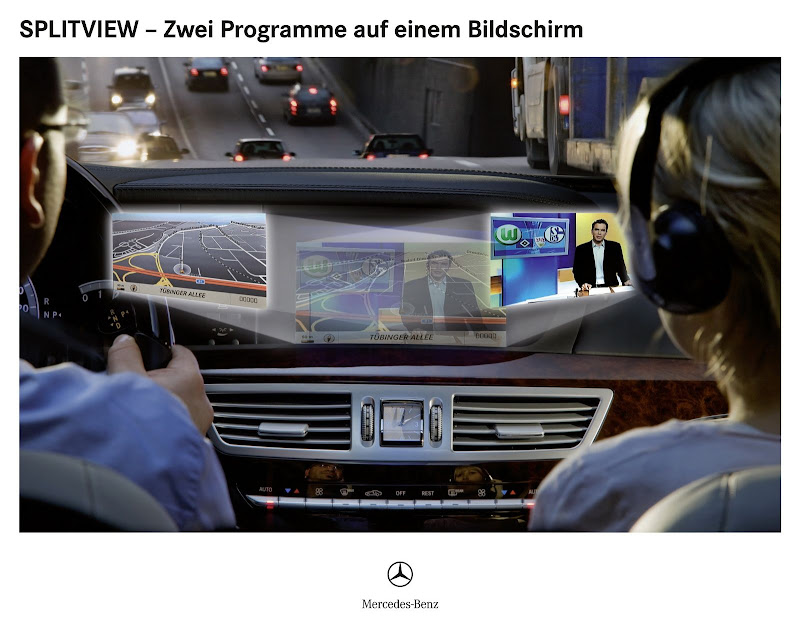
奔驰最新的SPLITVIEW技术


奔驰最新的SPLITVIEW技术将运用在2009款的小改款S级上。SPLITVIEW即分屏显示,但不是简单地将屏幕分成两部分显示,而是从两个不同角度上能看到两种影像!如图,S级8英寸的显示屏同时运行两个程序,司机位置看过去是GPS导航,并能操作COMAND系统,而副驾驶席位置看过去是另外的影像,比如DVD、电视什么的,同时用耳机收听音频。像魔术吧?效果怎么样,实用与否,明年夏天就知道了。
官方新闻

Innovative SPLITVIEW technology: Mercedes-Benz S-Class: two programmes on a screen
Stuttgart, Dec 10, 2008

Stuttgart – In future Mercedes-Benz is equipping its luxury class models as the first premium brand with a display screen that allows the driver and front passenger to view two different programmes at the same time. While the driver is checking the navigation instructions, the front passenger can sit back and watch a film on the very same display. This is made possible by new SPLITVIEW technology which the Stuttgart premium brand is introducing in the S-Class for the first time.

Mercedes-Benz has integrated the new SPLITVIEW technology developed by Mercedes-Benz and Bosch into the innovative control and display system COMAND, which is centrally located in the dashboard console. Its generously dimensioned, 8-inch (approx. 20 mm) monitor shows a backlighted active matrix colour display (TFT-LCD). This shows two different images simultaneously by placing pixels adjacent to each other. A filter masking the display divides this mixed image in such a way that depending on the seating position, only the pixels making up one or the other image can be seen. As a result, the driver and front passenger can view different programmes on the same screen at the same time.

The driver still has access to all the information from the control and display system COMAND on the display, while the front passenger uses the remote control to choose his own entertainment programme with DVDs, TV channels or music videos. To avoid distracting the driver with his entertainment programme, he also has the option of enjoying the programme via headphones. As before, the driver is able to view all the information provided by the COMAND system on the display.
Mercedes-Benz is introducing the new SPLITVIEW technology in the S-Class
for the first time in summer 2009.


© 2008 Daimler AG. All rights reserved.


阅读全文...

2008年11月14日星期五

《Popular Science》百佳科技发明——SL63变速器


SL63 AMG上出色的AMG SPEEDSHIFT MCT 7-speed变速箱荣获《Popular Science》杂志2008年“100个最佳科技发明”奖汽车类的第一名。


官方新闻

Affalterbach – The well-known American technical magazine "Popular Science" has made an award to the newly developed AMG SPEEDSHIFT MCT 7-speed sports transmission. During the "Best of what’s new Awards", the innovative power transfer of the SL 63 AMG high-performance Roadster achieved first place in the "Automotive" category.

The AMG SPEEDSHIFT MCT 7-speed sports transmission was able to claim victory in the hotly contested "Automotive" category. According to the editors of Popular Science, this AMG transmission represents "important and revolutionary technological progress". Popular Science has presented its sought-after "Best of what’s new Awards" annually in eleven categories since 1987. A total of 100 products enter the final selection. The results are published in the December edition, which traditionally has the largest circulation. Popular Science is the world's most widely-read science and technology magazine, with an average readership of 6.8 million each month.

The AMGSPEEDSHIFT MCT 7-speed sports transmission is a newly developed and unique power transfer unit that is used exclusively in the new Mercedes-Benz SL 63 AMG. It combines the best of both worlds: the sporty, direct and agile responsiveness of a manual transmission and the maximum comfort of an automatic transmission. Equipped with seven gears, four driving modes, a double-declutch function and a RACE START function, the AMG SPEEDSHIFT MCT 7-speed sports transmission excels with previously unattained flexibility. MCT stands for Multi-Clutch Technology, and indicates that gearchanges are executed solely by the clutch components.

No interruption in tractive power and four driving modes

The centrepiece of the AMG SPEEDSHIFT MCT 7-speed sports transmission is the wet start-off clutch, which operates in a sump and replaces the previous torque converter. Thanks to its low rotational inertia, this transmission is extremely responsive and dynamic, with movements of the accelerator immediately translated into motive power. Equipped with four driving modes, the transmission shifts the gears with no interruption in tractive power and provides tailor-made shift strategies for maximum driving pleasure. In "C" mode the gearchanges are comfort-oriented, with "soft" accelerator mapping for extremely smooth progress. In "S" mode the engine and transmission respond much more immediately, with more revs in each gear and faster downshifts. Gearshifts are also around 20 percent faster than in "C". Changing to driving mode "S+" shortens this time by a further 20 percent, while "M" provides the most sporty mode of all: now the 6.3-litre AMGV8-engine responds more sharply, and the transmission shifts the gears 10 percent faster – corresponding to a 50 reduction versus "C" mode. In "M" mode the gearchanges take only 100 milliseconds.

Particularly fast and responsive multiple downshifts are another major attribute of the AMG MCT sports transmission. Kickdown alows the driver to change from seventh directly to fourth gear, for example, or from fifth to second gear. In driving modes "S" (Sport), "S+" (Sport plus) and "M" (Manual) the automatic double-declutch function is active. This is not only a benefit in terms of the driver's emotional experience: the practically load-free downshifts minimise any load-change responses, which has an extremely positive effect when braking into bends on the racetrack.

AMG DRIVE UNIT with innovative RACE START function

The central control unit for the AMG SPEEDSHIFT MCT 7-speed sports transmission and all the dynamic functions is the AMG DRIVE UNIT. The electronic rotary switch for selection of the driving modes, including activation of the innovative RACE START function, is located to the left of the shift lever. Below this there are three keys for other functions: the first controls the ESP® system, the second the ABC suspension and the third, which bears AMGlettering, enables the driver to store the selected driving mode and the suspension setup. Briefly depressing the AMG key displays the configuration options, and longer pressure saves the preferred setups to memory.

The RACE START function opens up new dimensions in driving dynamics: it enables the driver of the SL 63 AMG to summon up the maximum acceleration potential while ensuring the best possible traction for the drive wheels. The optimal start-off engine speed is set fully automatically to give the SL 63 AMG the fastest possible acceleration – if required even to maximum speed. The driver does not need to perform manual gearshifts, as the AMG transmission changes the gears with the shortest possible shift times.

Most powerful roadster in its class with 386 kW/525 hp

Emotional performance courtesy of a technological masterpiece: the Mercedes-Benz SL 63 AMG. This high-performance roadster is powered by the 6.3-litre AMGV8-engine developing 386 kW/525 hp and 630 newton metres – which makes it the most powerful model with a naturally aspirated V8-engine in its class. The SL 63 AMG accelerates from 0 to 100 km/h in 4.6 seconds and has an (electronically limited) top speed of 250 km/h. Its unique combination of a high-revving concept and a large displacement represents the best of both worlds: high torque at low engine speeds combined with flexibility to set the pulse racing – a maximum of 7200 rpm is possible.

The AMG eight-cylinder engine features a wealth of technology adopted from motor sports: this includes the lightweight, particularly rigid closed-deck crankcase and cylinder walls with revolutionary LDS coating, as well as valve gear designed for high engine speeds with bucket-type tappets in the cylinder heads. Together with the variable intake manifold with two integrated throttle flaps, the flow-optimised intake and exhaust ducts ensure perfect cylinder charging and a high output.
This dynamic drive package is ideally matched by the suspension of the SL 63 AMG. The AMGsports suspension based on Active Body Control has been refined, and now features not only a new damper configuration but also completely revised elasto-kinematics. In the interests of greater agility and shorter braking distances, the front axle bearings, spring links and the radius rod , as well as individual strut bearings at the rear axle, have been reconfigured. Together with the improved, speed-sensitive power steering this makes the SL 63 AMG more directly responsive, with extremely precise, linear self-steering characteristics. The AMGsports suspension based on Active Body Control also allows a personal suspension setup. At the touch of a button either sporty characteristics with reduced roll angles and a stiff suspension setup, or a comfort-oriented setting for a high level of long-distance comfort can be selected.

The 3-stage ESP® with sports function is also unique. This system offers three
different control settings, and is a logical further development of the AMG ESP® philosophy. Using the ESP® key in the AMG DRIVE UNIT, the driver is able to choose between three modes – "ESP ON", "ESP SPORT" and "ESP OFF" – and the currently active mode is shown in the central display of the AMG instrument cluster.


Popular Science官方新闻

Conventional automatic transmissions shift too lazily for true car nerds, but most paddle-shifted automated manuals tend to feel herky-jerky around town. Mercedes’s AMG Speedshift combines the best of both worlds in a lightweight, compact package. It replaces a standard automatic’s torque converter with a series of interlocking clutch plates, which allow faster shifting than even a professional racecar driver can pull off. During our test in the powerful SL 63 AMG convertible, equipped with the seven-speed shifter, even the most diehard manual fan among us had to admit that if this is where automatics are headed, he can deal.

阅读全文...

2008年11月13日星期四

TecDay特别介绍:2009春新E、S级的安全系统


明年的新E、S级将会相当安全,它们的安全系统有12项更新,肯定会是同级车安全性的标杆。ABS, ESP®, Brake Assist(辅助刹车)和PRE-SAFE®都是奔驰久经考验的安全系统,现在又加入了:
  • 摄像头,用来识别路边的指示牌,识别限速;使头灯随周围环境自动调整;把车保持在车道上。


  • 车头大灯自适应辅助系统:E级将是世界上第一款使用该系统的车型;可以侦测周围环境做出调整,比如照明的范围大小,并能使对面的车看到不刺眼的大灯。


  • 偏离车道警告系统:可以在车子偏离车道时通过振动方向盘来提醒司机。


  • 注意力侦查辅助系统:通过反向盘转动角度传感器,侦测出瞌睡的司机,并用语音和屏幕信息提示:“ATTENTION ASSIST. Break!”。更令人高兴的是,这玩意儿在E和S级上是标配。


此外还有进一步加强的PRE-SAFE®、DISTRONIC PLUS、Brake Assist PLUS、PRE-SAFE® Brake。
奔驰在研发过程中,进行了150多次实车碰撞试验、17000次拟真碰撞试验,其中包括40种撞法。


官方新闻

In the new E-Class and S-Class from spring 2009: Synergy of sophisticated safety technologies makes new Mercedes models part of the "thinking" process
Leipzig – By introducing around a dozen new or modified systems, Mercedes-Benz is adding a new chapter to its long history of passenger- car safety. Following on from their successes achieved in the domain of occupant protection, the Mercedes experts will be focussing more than ever on avoiding traffic accidents and reducing accident severity, with the driver assistance systems being unveiled in the new E-Class and the model year 2009 S-Class from spring 2009 onwards set to play a crucial role. Mercedes-Benz is implementing a globally unique synergy of sophisticated safety technologies to give its cars extra "senses" and added intelligence. All of which makes Mercedes models part of the "thinking" process – cars that can see, sense and act autonomously. In addition to this, the Mercedes saloons show the way ahead when it comes to occupant protection and set new standards with their "electronic" crumple zones.

Like tried-and-trusted Mercedes inventions such as ABS, ESP®, Brake Assist and PRE-SAFE®, the new assistance systems have been adapted based on real-life
accident findings. The aim behind their development was to prevent extremely frequent types of collision and collisions with serious consequences by focussing on the causes of accidents: distance to other vehicles, speed, drowsiness, darkness and lane departure.

To this end, Mercedes-Benz is for the first time using camerasalongside radar sensors. These long-range cameras monitor the area around the car and are able to interpret critical situations. By way of example, new camera-based assistance systems help the driver by keeping the car safely on track, detecting speed-limit signs, controlling the headlamps in line with the current driving situation and enhancing visibility in the dark.

The new E-Class will be the world's first car to feature headlamps that adapt automatically in line with the current driving situation. Adaptive Highbeam Assistdetects oncoming vehicles or moving vehicles in front with their lights on and adjusts the headlamps continuously so as to always provide the best possible headlamp range – without dazzling other motorists. In this way, the low-beam range can be increased from its current level of 65 metres to up to 300 metres.
If the road ahead is clear, the system switches to high beam with a minimum of fuss. This Mercedes development is therefore fundamentally different to conventional systems of this type, since the latter merely switch between low beam and high beam.

Adaptive Highbeam Assist: the best possible light in any traffic situation

Tests show that motorists who use Adaptive Highbeam Assist are safer on the road in the dark because they see pedestrians, cyclists or obstacles on the road up to 150 metres earlier than is the case with conventional low beam. What's more, the system helps to relieve driver stress as there is no longer any need to repeatedly flick the stalk on the steering wheel. So the driver can concentrate more on actually driving the car. Once activated, Adaptive Highbeam Assist always provides the best possible headlamp range.

At the heart of the system is a camera, located on the inside of the windscreen, which sends new data every 40 milliseconds so that the range of the variable-control bi-xenon headlamps can be adjusted.

Mercedes-Benz has further developed its Night View Assist system, which illuminates a long stretch of the road ahead using invisible infrared light. The second generation of this system features a special pedestrian detection function: as soon as the system detects pedestrians ahead of the car, they are highlighted on the display.

Lane Keeping Assist: warning if the car leaves its lane

Another new assistance system developed by Mercedes can prevent accidents caused by the car leaving its lane. More than a third of all road users killed in Germanyare involved in this type of accident. This is why Mercedes-Benz has developed
a "forward-looking" system for safe motoring called Lane Keeping Assist. Its camera monitors the line taken by the car and the driver's control inputs on a permanent basis, allowing the system to detect when the car leaves its lane unintentionally and if there is a risk of an accident. If this is the case, the system warns the driver in plenty of time, prompting them to counter-steer by making the steering wheel vibrate with a series of short, clearly discernable pulses.

Unlike conventional systems of this type, the Mercedes assistance system also assesses the driver's actions and, by doing so, can ascertain reliably whether the car has left its lane intentionally or unintentionally. There is therefore no warning if, for example, the driver accelerates before overtaking or joining a motorway, brakes heavily or steers into a bend.

If the system detects that the car is leaving its lane unintentionally, it activates an electric motor in the steering wheel, causing the steering wheel to vibrate.
The timing of the warning depends on the width of the road and the type of lane markings. If the car crosses over a continuous line marking on the road, as opposed to a broken line, the system emits its warning earlier.

Speed Limit Assist: a camera with an eye for traffic signs

A further new assistance system reminds the driver of the current speed limit in force: the camera on the windscreen detects speed-limit signs as the car drives past them and then indicates the speed limit on the display in the speedometer. The driver therefore remains fully aware of the current speed limit, enabling them to adapt the car's speed accordingly. The display goes out as soon as the speed limit is lifted.

Thanks to the huge strides forward made in image-processing technology, Speed Limit Assist is able to work in real time, analysing the images within a fraction of a second – as the car drives past – and providing the driver with the required information instantaneously. Plus it makes no difference whether the speed-limit sign is at the side of the road or on a gantry above the road.

Furthermore, Speed Limit Assist evaluates the data provided by the navigation

system's digital map, allowing it to check the plausibility of the camera image. By way of example, the last speed limit detected disappears from the display as soon as the navigation system detects that the car has entered a built-up area.

ATTENTION ASSIST: drowsiness detection system fitted as standard in the E-Class and S-Class

Thanks to a new technology, future Mercedes models will have a keen sense of their drivers' awareness. The aim is to detect driver drowsiness in plenty of time so as to warn them before they fall asleep momentarily. According to scientific studies, around a quarter of all serious motorway accidents are caused by driver drowsiness.
The new ATTENTION ASSIST system is equipped with highly sensitive sensors which monitor the driver's behaviour, the current driving situation and over 70 other parameters. By doing this, the system is able to detect when the driver's concentration starts to slip. This permanent form of monitoring is important for detecting the floating transition from awakeness to drowsiness and for warning the driver at an early stage. In addition to the speed, lateral acceleration and longitudinal acceleration, the system also detects use of the turn indicators and pedals as well as certain control inputs and external influences such as side winds or road unevenness, for example.

Observation of steering behaviour has proven to be extremely meaningful.
Field tests carried out by the Mercedes engineers over a period of several years, involving over 550 participants to date, show that drowsy drivers make minor steering errors that are often corrected quickly and abruptly. These are detected by a highly sensitive steering wheel angle sensor. If ATTENTION ASSIST detects typical indicators of drowsiness based on these and other data, it warns the driver by emitting an audible signal and flashing up a message on the display: "ATTENTION ASSIST. Break!"

ATTENTION ASSIST will be specified as standard for the new E-Class and the model year 2009 S-Class.

PRE-SAFE®: tensioning of the seat belts before an unavoidable accident

Further standard equipment Mercedes-Benz offers for these models includes the PRE-SAFE®anticipatory occupant protection system. Based on information received from sensors, it identifies situations that might turn into accidents and instinctively activates preventive occupant-protection measures, allowing the seat belts and airbags to deploy with maximum effect in the event of an impact. PRE‑SAFE® therefore bridges the gap between active safety and passive safety; it is networked to Brake Assist and the Electronic Stability Program (ESP®), whose sensors recognise potentially dangerous driving situations and then transmit this information to the electronic control units within milliseconds.

In another first, Mercedes-Benz will also be using the information provided by
the short-range radar to trigger the seat belt tensioners at the very last moment before an unavoidable collision, thus greatly reducing the forces exerted on the driver and front passenger during the crash.

Radar technology: sensor with medium-range detection capability and greater range

DISTRONIC PLUS and Brake Assist PLUS – Mercedes assistance systems based on sophisticated radar technology – are highly effective at helping to prevent accidents. Analysis of accident-research data has shown that this technology can prevent a fifth of all head-to-tail crashes in Germany on average. On motorways, the accident rate can be reduced by as much as 36 percent.

Mercedes-Benz has further enhanced the radar technology for the new E-Class and the model year 2009 S-Class. The newly developed long-range radar sensor will have a range of 200 metres instead of 150 metres as previously. In addition, the sensor now has medium-range detection capability, allowing monitoring of the area up to around 60 metres ahead of the car with a 60-degree beam width. This new technology enables even more accurate monitoring of the traffic situation in front of the car and even better detection of dynamic events such as a car in front swerving suddenly. The two wide-beam short-range radar sensors (80-degree beam width) with a range of around 30 metres are still employed.

PRE-SAFE® Brake: autonomous emergency braking as "electronic" crumple zone

As well as warning drivers in the new E-Class and the S-Class of an imminent head-to-tail crash, radar technology can also assist with emergency braking. The sensors are networked with Brake Assist PLUS, which automatically calculates the brake pressure required to prevent an imminent collision. This braking assistance, available as soon as the driver hits the brake pedal, allows controlled, targeted braking or – if necessary – emergency braking, depending on the car's speed and the distance to the vehicle in front.

If the driver fails to react to the warnings given by Brake Assist PLUS, the PRE-SAFE® Brake intervenes and brakes the car autonomously: around 1.6 seconds before the calculated impact point, the system initiates autonomous partial braking and decelerates the car with around 40 percent of the maximum braking power.

In the new E-Class and the model year 2009 S-Class, this safety system provides a further function: if the driver still fails to act after automatic partial braking, the PRE-SAFE® Brake activates the maximum braking power around 0.6 seconds before the now unavoidable impact and, as a consequence, can greatly reduce the severity of the accident. The system therefore acts like an "electronic crumple zone", offering the car occupants even greater protection.

Occupant protection: over 150 crash tests for the highest possible level of Mercedes safety

During the course of its development to date, the new E-Class has successfully come through over 150 high-speed crash tests and more than 17,000 realistic crash simulations, including around 40 different crash tests which the saloon had to pass in order to gain world-wide approval and nine extremely demanding, in-house impact tests, some of which go well beyond the statutory requirements.

The Sindelfingen-based engineers have continued to perfect the crumple-zone principle invented by Mercedes safety pioneer Béla Barényi. The front deformation zones of the latest Mercedes passengers cars work on several levels – making them even more effective as the impact forces are distributed over a wide area and can be made to bypass the passenger cell. Likewise the increased use of ultra-high-strength steel alloys helps the bodyshell to withstand high impact loads. These steel grades offer maximum strength whilst minimising weight. Around 72 percent of all the bodyshell panels for the new E-Class are made from sophisticated high-tech steel grades – a new record in passenger-car development.

With a total of seven airbags fitted as standard, not to mention seat-belt tensioners, belt force limiters and NECK-PRO crash-responsive head restraints, the new E‑Class will offer an even more extensive package of safety equipment than its predecessor. Self-adaptive belt-force limiters in the rear, which adapt automatically to suit the size of the rear passengers, will be introduced for the first time in autumn 2009.

Pedestrian protection: new E-Class with active bonnet fitted as standard

Mercedes-Benz is continuing its long-standing and very successful commitment to protecting those road users who are most at risk. Standard equipment for the new E-Class includes an active bonnet, which greatly reduces the risk of injury to pedestrians. In the event of an accident, a system of springs raises the rear section of the bonnet by 50 millimetres within milliseconds, thus enlarging the deformation zone. One special feature of this Mercedes system is its reversibility: drivers can reset the active bonnet themselves without having to visit a workshop.


阅读全文...